
Skills-based hiring is the best defense against AI
Here's the hiring state-of-play in 2026. An AI writes the resume. An AI screens the resume. An AI preps the candidate for the interview, and increasingly, an AI conducts the first round too. And somewhere in there, a human still has to make a decision based on something real.
This isn't a fringe trend. McKinsey's The State of AI 2025 finds nearly nine in ten organizations now use AI regularly, and half use it across three or more business functions. Hiring sits on both sides of that statistic: the candidates applying with AI and the teams screening with it.
Recruiters feel it every day. Application volumes are up, quality is down, and every resume that lands in the funnel looks suspiciously polished. The question isn't whether AI has changed hiring (it has, completely), the question is what still works.
Our answer, backed by data rather than wishful thinking, is skills-based hiring (SBH).
AI broke every traditional hiring signal
Traditional hiring was built on signals like degrees and experience. For a long time, these seemed to work (however, the data would argue that they never really did) for one reason: producing a convincing one took effort that roughly tracked the ability you cared about. A sharp resume, a tailored cover letter, or a fluent interview answer. Each was a proxy, and the proxy held up because faking it well was almost as hard as having the real thing.
But AI has severed that link. A convincing signal is now one prompt away, whether or not the underlying ability exists. The resume isn't lying more than it used to. The small amount of real information it carried has been diluted to near zero. The rehearsed interview answer arrives pre-optimized by a chatbot that has read every "top 50 interview questions" article ever written. The cover letter? Don’t get us started.
Simply put, in the world of AI, hiring looks very, very different.
Here’s a useful framing we like to use: Don't ask, “Are candidates cheating?”, ask "What does this signal cost to fake?" If the answer is one prompt, the signal is dead, no matter how good it looks. And by that test, almost everything traditional hiring has run on isn’t telling you anything.
And the damage is already on payroll. In our report on the State of Hiring for AI Fluency 2026, our survey of nearly 2,000 senior hiring leaders found that 59% of organizations report making a bad AI hire. I.e., someone who navigated the interview flawlessly, named the tools, described the workflows, and then couldn't apply any of it on the job. The interview signals were perfect, but the ability behind it wasn't there.
But skills-based hiring is how you can fight back.
What is skills-based hiring?
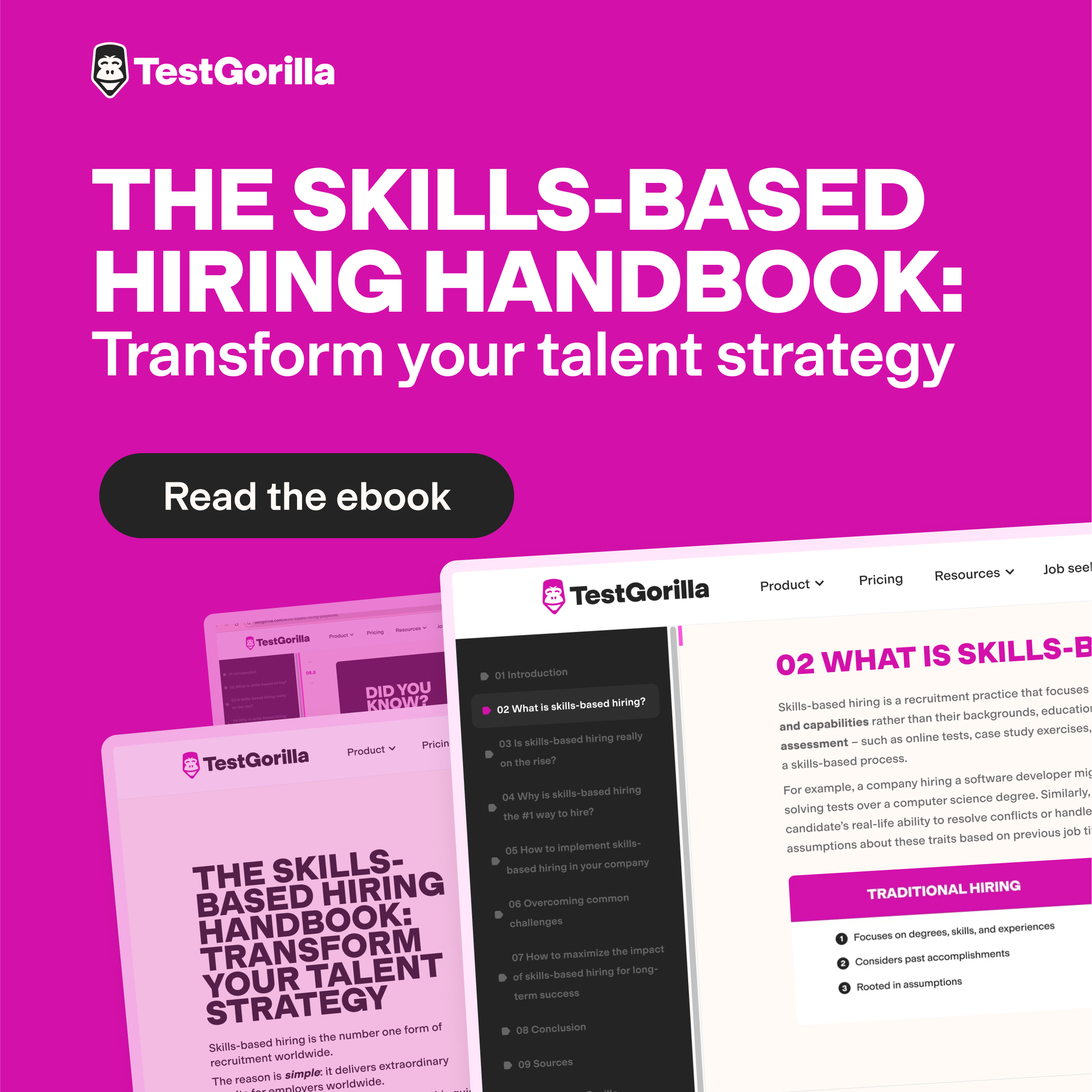
SBH evaluates candidates on demonstrated, job-relevant abilities instead of credentials like degrees, job titles, and years of experience. Instead of treating the resume as a proxy for capability, employers use structured assessments, work samples, and structured interviews to see who can actually do the job.
It wasn't invented as an answer to AI. It was built to fix the older problem in that resumes were always weak predictors of success. Resumes filtered out self-taught talent and career-changers, smuggled in bias, and predicted job performance poorly. The case was already strong before ChatGPT existed. In The State of Skills-Based Hiring, 94% of employers agreed that skills-based hiring is more effective at identifying talented candidates than resume screening, 90% reduced mis-hires, and 91% improved retention.
AI didn't create the resume's weakness. It just made that weakness, like when someone has something stuck in their teeth, impossible to ignore
The best insights on HR and recruitment, delivered to your inbox.
Biweekly updates. No spam. Unsubscribe any time.
What AI changed about skills-based hiring
Skills assessments aren't magically exempt from the same force. An unsupervised, remote test that asks someone to produce an output AI can also produce no longer measures skill. It measures access to AI, which everyone has. "Test the skills" is no longer enough as a philosophy. What you test, and under what conditions you test it, is now the whole game.
The data backs this up, and it isn't an effort problem. Our AI fluency research found that 95% of organizations list AI competency as a formal hiring requirement, and 71% have formally defined what AI fluency means for their teams. Yet 59% still made a bad AI hire. Organizations are trying hard. Their instruments are measuring the wrong thing: vocabulary and confidence instead of applied capability.
The thing worth measuring has shifted too. When AI does a large share of the grunt work, the value of human contribution moves up a level. It becomes about judgment vs strict execution. Knowing when the output is wrong, framing the problem, choosing what not to automate, verifying claims, and improving selection. The person who spots the confident error in an AI draft is now more sought after than the person who writes the draft slowly by hand.
The market seems to agree. McKinsey reports that 32% of organizations expect AI to shrink their workforce in the year ahead. And with much of that work targeting entry-level, easier-to-automate roles, the work that remains will require more of this exact kind of judgment.
So skills-based hiring in 2026 means something more demanding than it did in 2022. Less "can you produce this output unaided" and more "can you exercise judgment over work that AI is partly doing."
Why skills-based hiring holds up vs AI
Here's why it remains the best defense available, and arguably the only one:
A resume is a claim. An assessment is an instrument. You can't redesign the resume to resist AI. It's a self-reported document, and self-reports are exactly what AI fakes best. An assessment is different. You control what it asks, what it watches, and what it scores. When AI gets better at faking one format, you change the format. Think of the resume as a press release, while a well-built assessment is a live demo.
Performance happens in front of you. Skills-based hiring puts the candidate in the position of doing something observable: solving a problem, working a simulation, or defending a decision. AI can ghostwrite a claim about ability. It's far worse at standing in for ability in real time, under structure, and across formats.
Multiple measures beat fakes. Any one signal can be gamed, a skills test included. But a candidate who has to perform consistently across a cognitive test, a role simulation, and a structured interview will struggle to outsource that coherence to a chatbot. The combination and consistency are what's hard to fake. That's why multi-measure testing isn't a nice-to-have. It's the mechanism that makes the whole approach AI-resistant.
Friction filters the slop. Candidates now spray AI-generated applications at scale, and the strong candidates drown in the flood with everyone else. Matter of fact, it’s predicted that by 2028, 25% of candidates won’t even have a pulse. A real assessment adds friction that works in your favor. A task that costs a serious candidate fifteen focused minutes deters the spray-and-pray applicant almost regardless of how it scores. Fifteen focused minutes is the new cover letter, except this one actually filters, and people don’t hate it.
No other approach offers this. Credential checks verify the past, not the ability. Unstructured interviews reward rehearsal, and AI prep has turned rehearsal into a science. SBH is the only method where the evidence is generated fresh, in conditions you design.


How to avoid AI slop clogging your funnel
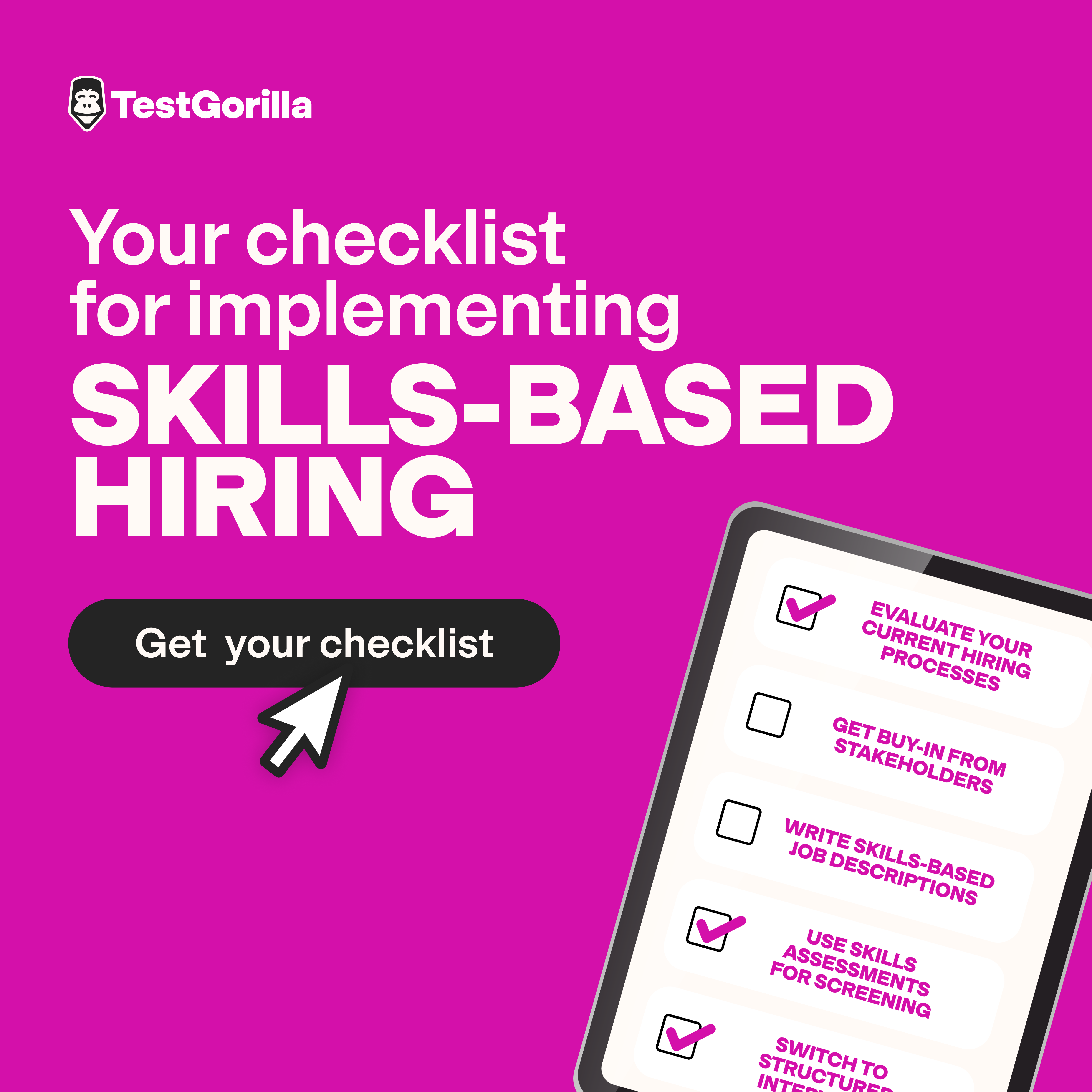
Here's some actionable advice on how to implement SBH stage by stage in your hiring process to find those diamonds in the rough:
1. Demote the resume to context
Stop ranking or rejecting based on the resume alone. The information isn't in there anymore. Use it to shape the questions you ask later, nothing more. Evidence comes from what candidates do next.
2. Put a real assessment first
Move a short, job-relevant assessment to the front of your funnel, before any human reads a single application. It screens for ability and commitment at the same time, and it gives every candidate the same shot, which the resume never did.
3. Stack your measures
Never let one score decide a hire. Combine a cognitive test, a role-specific simulation, and a structured interview, and look for consistency across all three. One async signal is soft. A coherent pattern across formats in real time is the thing AI can't yet manufacture for a candidate.
4. Test judgment over AI, not just output
Your next hire will use AI on the job, so measure how well they use it. The market already knows this: 53% of hiring managers now prefer a candidate with high AI fluency over one with deep domain expertise. McKinsey tracks rising demand for AI skills in roles as varied as claims adjusters, digital marketers, and wealth managers. This isn't a developer-only requirement anymore.
The follow-through hasn't caught up. Only 26% of organizations require candidates to demonstrate independent AI use and verify the results as part of hiring. That number should be the floor, but right now it functions as the ceiling. Hand candidates a flawed AI output and ask them to find what's wrong. Ask what they would never delegate to a model and why. These tasks get more informative as AI improves, not less.
5. Match conditions to stakes
For high-stakes roles, include a live or supervised component. Asynchronous outputs alone are now too easy to fake to carry a big decision. Yes, live evaluation costs more. But the mis-hire it prevents saves even more.
Hire for what AI can't fake
The era of taking hiring signals at face value is over, and it isn't coming back. That's bad news for the resume, the cover letter, and the unstructured interview. It's not bad news for you, provided you measure what candidates can do under conditions you control, and never let one fakeable signal make the decision.
That's the system we built at TestGorilla. 350+ validated assessments, role simulations, structured AI interviews, and resume scoring in one platform, so you can stack measures instead of stitching together point solutions. Every score is explainable and benchmarked against expert ratings, not pulled from a black box.
AI made talk cheap. Make your candidates show you instead.
Try TestGorilla for free or explore the test library to see what your next hire can really do.
You've scrolled this far
Why not try TestGorilla for free, and see what happens when you put skills first.