

Free download
THE AI INTERVIEW CHEAT SHEET
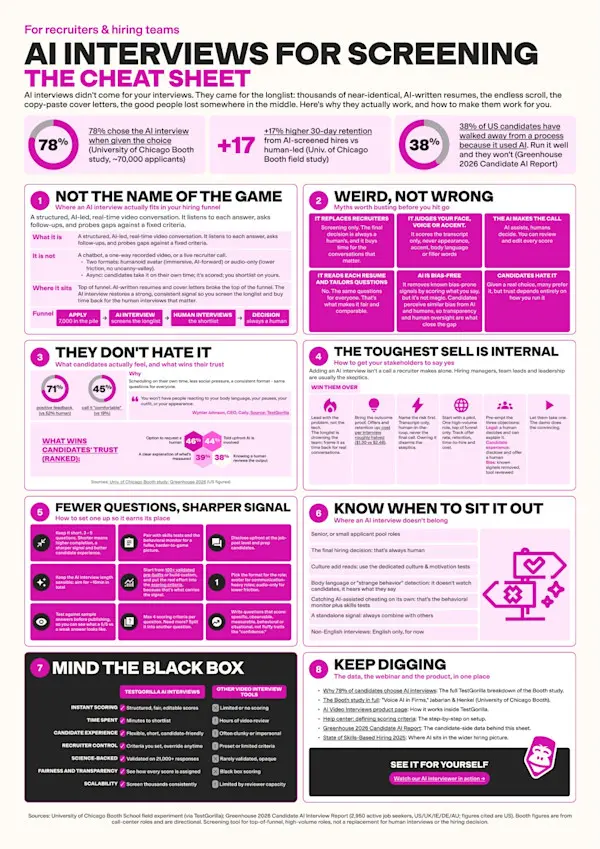
A single role can pull hundreds, or even thousands, of applications. When AI writes half of them, the strong and the average look identical. The resume stops telling you much, and screening every one by call just doesn't scale. AI interviews exist to fix exactly that, screening the longlist so you get to the real conversations sooner. But only if you run them well. So we've put everything worth knowing on a single page:
Where AI interviews actually fit (and where they absolutely don't)
The myths worth busting before you hit go
What candidates really think, straight from the data
How to win over the stakeholders who aren't convinced yet
How to set one up so it earns its place
TestGorilla vs other video interview tools, side by side
The stats, the sources, and where to go deeper
WALK AWAY KNOWING:

How AI interviews unlock consistent, bias-aware screening at scale

How to set one up without ruining the candidate experience

How to maintain candidate trust when using one
SCREEN THE LONGLIST. KEEP THE HUMAN BIT.
TestGorilla's AI Interviews handle the repetitive first-round screening that eats your week, so the calls you do make are the ones really worth having. Your questions, your criteria, scientifically-backed scoring you can see and defend.
Read blogs about HR:

How to put people first: A guide for HR leaders
Numerous companies say they’re “people first,” but it’s just a buzzword for too many of them. If you claim to put people first without living and breathing the values accompanying it, your employees will notice and leave. Putting people first is about improving your company culture and having leadership who thinks about the people driving your company forward. Clarifying and embedding these values into your company makes you a people first organization – a place where people want to work. This article discusses what putting employees first means, its benefits, and the actionable strategies to put people first.

HR technology trends: What to expect in the future of work
Technology advancements have revolutionized HR management, providing software applications and HR platforms to store key data, automate tasks, and inform decision-making. It also has a positive impact on employees: A study by Qualtrics found that workers who use technology to boost productivity are 158% more engaged than those who don’t. They are also 61% more likely to stay with their employer. The challenge is choosing which HR tech to use. New HR technology trends surface all the time, and identifying the ones that will most benefit your organization can be tough. In this article, we talk you through the latest trends in HR technology to help you as you assemble your HR tech stack.

Top 7 HR assessment tools: A summary
HR assessment tools help refine your recruitment process, enabling your HR department and hiring managers to ensure a positive candidate experience, streamline talent assessments, improve hiring accuracy, and reduce time-to-hire. This article outlines seven leading HR assessment platforms that help you evaluate and find the right candidates and improve your recruiting efforts. These tools include features built to leave a positive impression on your applicants, such as user-friendly interfaces and flexibility.

HR tech stack: What tools to include for streamlined people processes
A study by ADP Research Institute shows that HR-to-staff ratios are on the rise, with the average company having 2.6 HR staff for every 100 employees. Here’s the problem: More HR staff isn’t a guarantee of effectiveness. The Global Talent Climate report found that the average time-to-hire is increasing across industries despite larger HR teams. If you experience this issue, chances are, you don’t lack talent acquisition skills – what you lack is efficiency in talent management processes. Using the right HR technology increases your efficiency by: Streamlining routine tasks Reducing errors Maximizing time for high-value projects like optimizing hiring or improving employee experience In this blog post, we show you how to build your HR tech stack, including the most popular HR technology tools to include. But first, what do we mean by “HR technology stack”?