Ask most UK business owners what a hire costs and they will name the salary. Ask a finance director and you will get a longer answer. The salary is only the start. Agency fees, employer National Insurance, the weeks a seat sits empty and the risk of getting it wrong all add up, and in 2026 several of those numbers have moved in the wrong direction.
This guide breaks down where the money actually goes, and what UK small and mid-sized enterprises (SMEs) and consultancies can do to bring it down.
Table of contents
- The headline number: what UK employers say they spend
- Agency fees: the biggest single line item
- Employer National Insurance: every hire costs more than it did
- Time-to-hire: the cost of an empty seat
- The cost of a bad hire
- What the market looks like right now
- Five practical ways to cut the cost of a hire
- Where TestGorilla fits
- Sources

The headline number: what UK employers say they spend
The Chartered Institute of Personnel and Development (CIPD)'s Resourcing and talent planning report 2026 (September 2026, 1,014 HR professionals) puts the median cost per hire at:
£3,500 for senior managers and directors (up from £2,000 in 2024), rising to £5,000 in the private sector.
£2,000 for other employees (up from £1,500 in 2024).
The CIPD notes this is the first rise after a downward trend, and that small subsamples mean the figures should be treated with some caution. But the direction is clear.
These are also recruitment costs: advertising, tools and fees. They do not include the bigger hidden costs below.
Agency fees: the biggest single line item
If you use a contingency recruitment agency, the fee usually dwarfs everything else. A 2026 UK fee guide from Recruitly puts standard contingency permanent fees at 15-20% of first-year salary, 18-22% for tech roles (higher for niche skills such as artificial intelligence/machine learning (AI/ML) or security), and 25-33% for retained search.
To make that concrete: IT Jobs Watch shows a UK median advertised salary of £70,000 for software engineers in the six months to 13 October 2026. At an 18-22% fee, one agency hire at that salary costs roughly £12,600 to £15,400 in fees alone. Make five of those hires a year and you are paying for a sixth engineer you never get.
Many firms are already pulling this in-house. The same CIPD report found 53% of organisations now do all recruitment in-house through direct hiring, up from 47% in 2024 (49% in the private sector).
The best insights on HR and recruitment, delivered to your inbox.
Biweekly updates. No spam. Unsubscribe any time.
Employer National Insurance: every hire costs more than it did
Since 6 April 2025, employer (secondary Class 1) National Insurance has risen from 13.8% to 15%, and the threshold at which employers start paying has dropped from £9,100 to £5,000 per employee per year. The Employment Allowance rose from £5,000 to £10,500, with the £100,000 eligibility cap removed (Brightmine HR Centre summary; legislation.gov.uk explanatory notes).
For a single £70,000 hire, that works out at:
Before April 2025: (£70,000 - £9,100) x 13.8% = £8,404
Now: (£70,000 - £5,000) x 15% = £9,750
That is roughly £1,346 more per year, per hire, before the Employment Allowance is applied. The allowance helps smaller employers, but it is a fixed pot. Once a growing team has used it up, every additional hire carries the full cost.
The practical point: when each hire costs more to employ, a wrong hire costs more to carry.
Time-to-hire: the cost of an empty seat
The longer a role stays open, the more it costs, even if no invoice arrives. SmartRecruiters analysis of 89 million applications (reported March 2025, data from September 2023 to August 2024) found UK roles took an average of 40 days to fill, slower than the US (35 days).
For a consultancy or software house, an empty delivery seat is lost billable time. A simple way to estimate it is: daily billing rate x utilisation x working days the role is open. Run that sum for your own business and the figure is often bigger than the agency fee.
Despite this, the CIPD found only 31% of organisations track time to hire. You cannot shorten what you do not measure.
The cost of a bad hire
There is no reliable single UK figure for the cost of a mis-hire, and we would rather not quote one that is not well sourced. What the data does show is that it is a growing risk:
58% of employers saw more applications from unsuitable candidates in the past year (CIPD, September 2026).
27% said candidates mostly or always made excessive use of AI in applications, and 21% have changed their assessment methods because of it (CIPD report).
Only 24% of organisations calculate the cost of staff turnover, falling to 15% among private-sector SMEs.
A bad hire means paying the fee, the salary, the higher National Insurance and the onboarding time, then paying most of it again. More polished, AI-assisted CVs make it harder to spot the wrong person early.
What the market looks like right now
Hiring is picking up, which tends to push costs higher. The KPMG and Recruitment and Employment Confederation (REC) UK Report on Jobs (published 10 October 2026, September data) showed permanent placements rising for a second month at the fastest pace in four years, with IT & Computing leading permanent demand. Candidate availability is still rising, but at the slowest rate in three years.
The Office for National Statistics (ONS) estimated 691,000 UK vacancies in July to September 2026 (published 20 October 2026). There are plenty of applicants overall. The hard part is finding the right one quickly.
Five practical ways to cut the cost of a hire

Screen for skills before you read a CV. Short, job-relevant skills tests filter out unsuitable and AI-padded applications before anyone spends interview time on them. The CIPD found 63% of organisations already use some form of test or assessment. In TestGorilla's own State of Skills-Based Hiring 2025 survey (UK and US, April 2025), two in three employers said skills tests had reduced mis-hires, and three in five said they had reduced time-to-hire.
Source candidates directly instead of paying a percentage. A 15-22% fee is mostly paying for someone to find and approach candidates. If your team can search and reach out to qualified people itself, that fee becomes optional rather than default.
Track three numbers. Time to hire, cost per hire and 90-day retention. Most SMEs track none of them. Even a spreadsheet will show you where the money leaks.
Use structured interviews. Ask every candidate the same job-related questions and score them against the same criteria. It is cheaper than a mis-hire and fairer to candidates.
Keep agencies for the roles that need them. Truly niche or senior searches can justify a fee. Routine, repeatable roles usually cannot.
Where TestGorilla fits
TestGorilla helps you do the first two steps without adding headcount. Skills assessments let you rank applicants on what they can actually do.
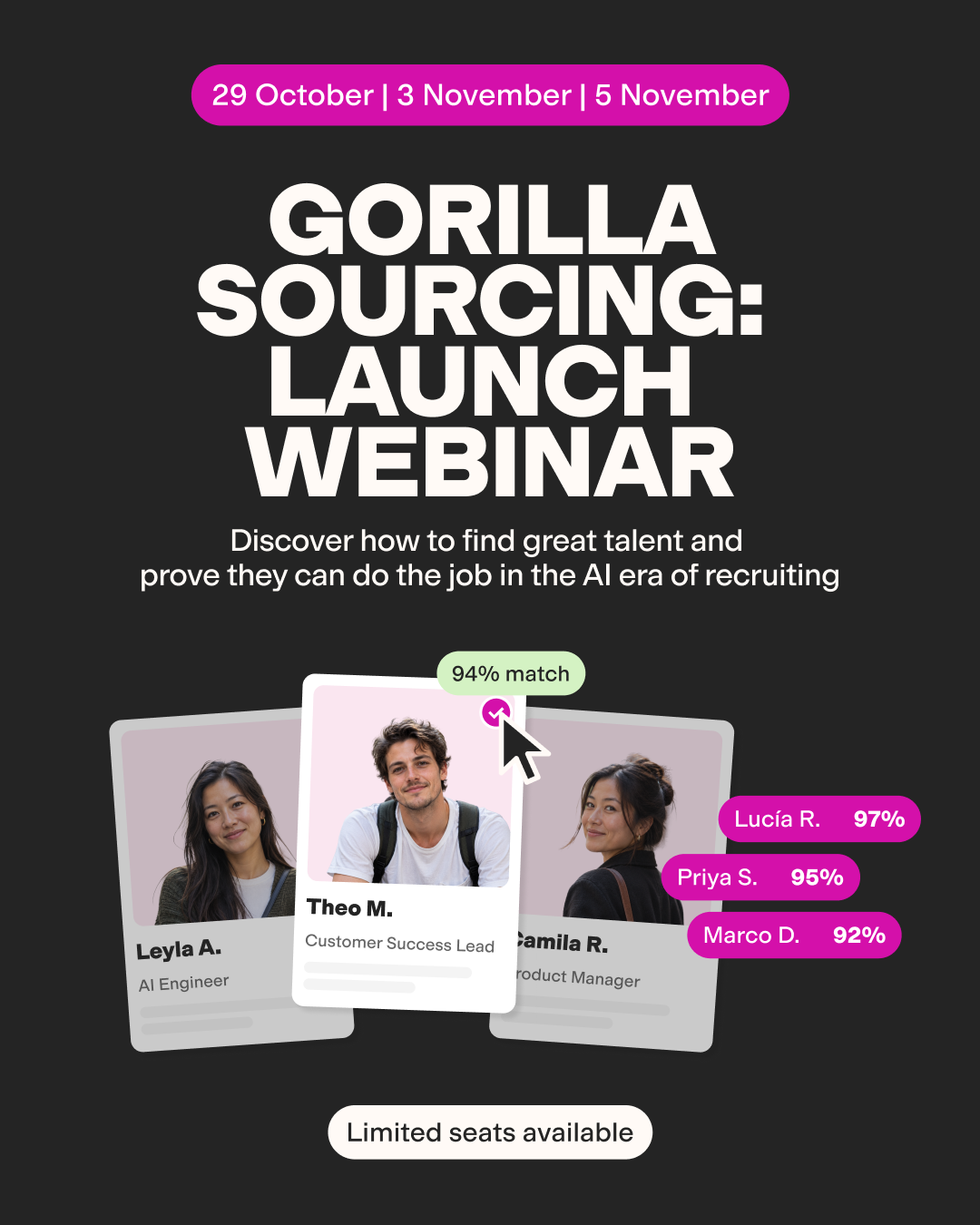
Gorilla Sourcing, launched on October 2026, searches 900M+ candidate profiles to find people who match your role and reaches out to them for you, so you are not relying on inbound applications or agency shortlists alone.
Join the free webinar
See how it works in practice at our free webinar, Recruiting in the AI era: Gorilla Sourcing. The UK session runs on 29 October at 10:00 UK time.
Not ready for a webinar? Try TestGorilla free and run your next role through a skills assessment.


Sources
CIPD, Resourcing and talent planning report 2026 (September 2026)
CIPD, Employers upskilling as labour market cools and costs rise (22 September 2026)
Recruitly, Recruitment agency fees 2026 (2026)
IT Jobs Watch, Software Engineer job trends, UK (6 months to 13 October 2026)
Brightmine HR Centre, Increase in employer NICs and changes to Employment Allowance
legislation.gov.uk, National Insurance Contributions (Secondary Class 1 Contributions) Act 2025, explanatory notes
Staffing Industry Analysts, UK businesses take 40 days to fill job roles, study finds (21 March 2025, SmartRecruiters data)
KPMG and REC, UK Report on Jobs, October 2026 (10 October 2026)
ONS, Vacancies and jobs in the UK (20 October 2026)
TestGorilla, The State of Skills-Based Hiring 2025 (2025)
You've scrolled this far
Why not try TestGorilla for free, and see what happens when you put skills first.