How UK consultancies and software houses can hire technical talent at volume

If you run a consultancy or software house, hiring is not an occasional project. Win a new client and you might need four developers, a delivery lead and a business analyst within a quarter. Lose a month finding them and you lose revenue, or the client.
For many firms the default playbook is two things: brief an agency and buy a LinkedIn Recruiter seat. Both have their place. Neither scales cheaply when you are hiring repeatedly for similar roles. This guide sets out a more repeatable approach, built on skills-first screening, direct sourcing and a structured process.
What the UK tech hiring market looks like in late 2026
The market is moving again, especially for technical roles.
Permanent hiring is recovering. The KPMG and Recruitment and Employment Confederation (REC) UK Report on Jobs (published 10 October 2026, covering September) found permanent placements rose for the second month running, at the strongest pace in four years. IT & Computing led the rise in permanent staff demand, and was one of only three sectors where temp demand grew.
Tech job ads are up. Analysis by APSCo, CV-Library and Lightcast (reported July 2026) counted 126,861 advertised UK tech vacancies in Q2 2026, up 4.3% year on year. Artificial intelligence (AI)-related vacancies rose 41.8% and permanent roles made up 88% of the total.
Overall vacancies are lower, but candidates are not easier to find. The Office for National Statistics (ONS) estimated 691,000 vacancies in July to September 2026, down 5.1% on the year, with 2.4 unemployed people per vacancy (published 20 October 2026). Vacancies in professional, scientific and technical activities were down 9,000 on the year.
That last point matters. More people are looking for work, but the Chartered Institute of Personnel and Development (CIPD) found 58% of employers saw more applications from unsuitable candidates in the past year (CIPD, September 2026). For technical roles, volume is not the problem. Signal is.
Longer term, specialist skills look tighter still. A Frontier Economics report for the UK Institute for Technical Skills & Strategy (March 2026) projects a shortfall of up to 120,000 technical professionals by 2035 across frontier areas such as AI and cyber security.
Why agencies and LinkedIn Recruiter alone do not scale
Agencies charge per hire. Tech placements typically cost 18-22% of first-year salary on a contingency basis, according to a 2026 UK fee guide from Recruitly. With a UK median software engineer salary of £70,000 (IT Jobs Watch, six months to 13 October 2026), that is roughly £12,600-£15,400 per hire. For a firm making ten technical hires a year, fees alone could pass £125,000.
One search channel means one candidate pool. If every firm in your market is searching the same platform with the same filters, you see the same people your competitors see, and so do the agencies you brief.
Both still leave you screening CVs. A shortlist of CVs does not tell you whether someone can actually write maintainable code or structure a client workshop. You still need to test that.
The best insights on HR and recruitment, delivered to your inbox.
Biweekly updates. No spam. Unsubscribe any time.
A repeatable model: four parts

1. Define roles by skills, not job titles
"Senior developer" means different things at different firms. Before you open a role, write down the five or six skills that actually predict success in it. For example: a specific language and framework, testing practice, working with legacy code, client communication, and estimation.
This list becomes your screening criteria, your interview guide and your sourcing search. Do it once per role family and reuse it.
2. Screen for skills first
Put a short, relevant skills assessment at the front of the process, before CV review. This does two things. It filters out unsuitable and AI-padded applications early, and it surfaces strong candidates with non-traditional backgrounds who would not get past a CV filter.
This is becoming standard practice. The CIPD's Resourcing and talent planning report 2026 found 63% of organisations use some form of test or assessment. In TestGorilla's State of Skills-Based Hiring 2025 survey (UK and US employers, April 2025), two in three employers said skills tests had reduced mis-hires.
For consultancies, test the client-facing side too. A developer who writes good code but cannot explain a trade-off to a client is a risk on billable work.
3. Source directly, not just reactively
Inbound applications and agency CVs only show you people who are already looking. Direct sourcing means searching for people whose skills match your criteria and approaching them yourself, including those who are not actively applying.
Done well, it is cheaper per hire than agency fees and gives you a pipeline you own. When the next client win lands, you already have warm candidates.
The CIPD found 53% of organisations now do all their recruitment in-house through direct hiring, up from 47% in 2024. The tools to do this at volume are now available to small and mid-sized enterprises (SMEs), not just enterprises.
4. Run a structured, fast process
Volume hiring falls apart when every hiring manager runs interviews their own way. Fix it with:
The same core questions for every candidate in a role family, scored against the skills list from step one.
A fixed number of stages. For most technical roles, an assessment, one technical interview and one culture or client-skills conversation is enough.
Agreed turnaround times. Feedback within two working days of each stage. Good developers have options.
Simple tracking. The CIPD found only 31% of organisations track time to hire. Track it, along with offer acceptance and 90-day retention.
A quick checklist for your next batch of hires
Skills list written for each role family
Assessment set up and placed before CV review
Direct sourcing search built from the same skills list
Interview scorecard shared with every interviewer
Agency use limited to genuinely niche or senior roles
Time to hire and cost per hire tracked from day one


Where TestGorilla fits
TestGorilla covers the screening and sourcing steps in one place. Skills assessments for developers, consultants and analysts let you rank candidates on ability before you read a CV.
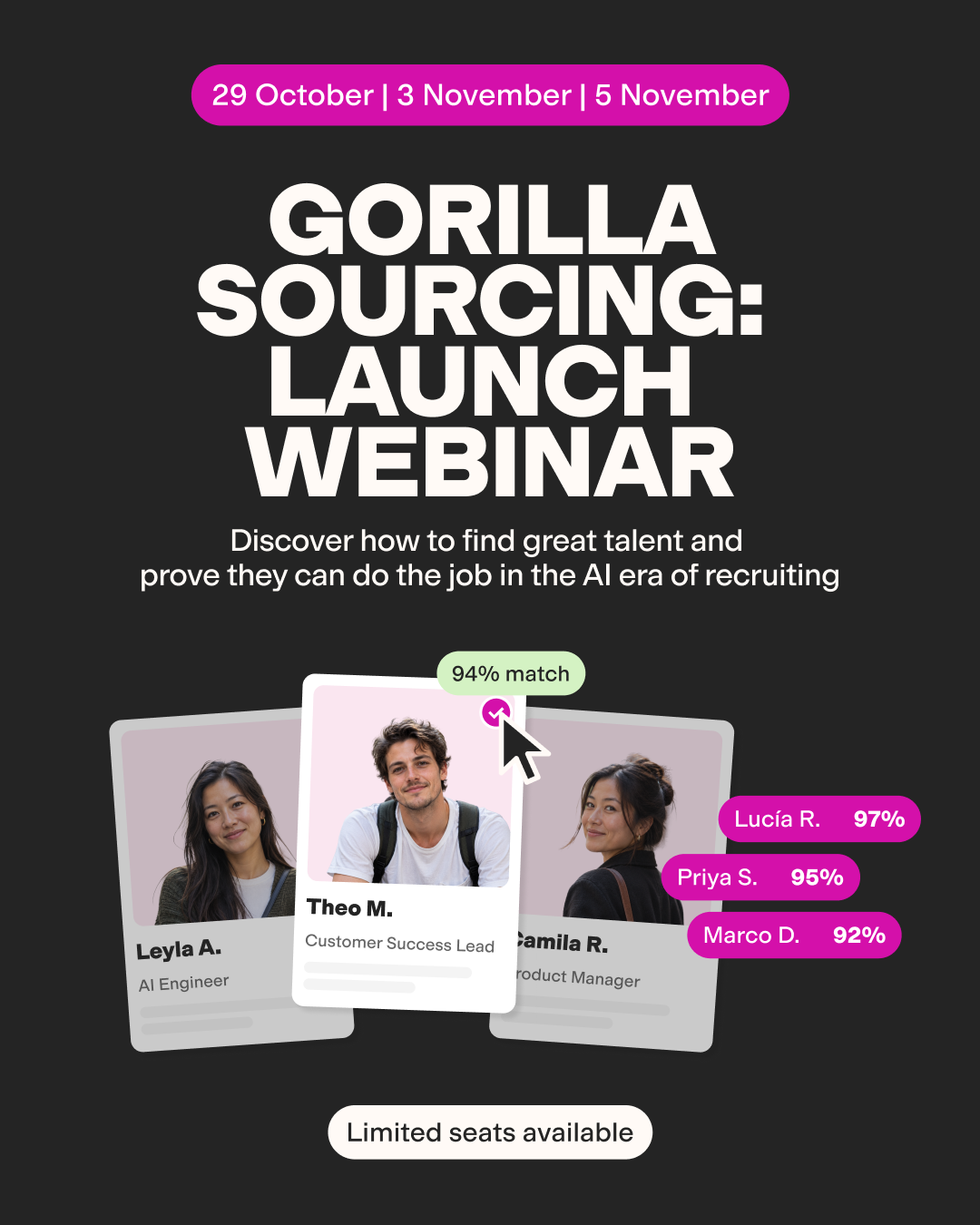
Gorilla Sourcing, launched on October 2026, searches 900M+ candidate profiles to find people matching your role and reaches out to them for you. That gives you a direct pipeline alongside, or instead of, agency shortlists and Recruiter searches.
Join the free webinar
See how it works in practice at our free webinar, Recruiting in the AI era: Gorilla Sourcing. The UK session runs on 29 October at 10:00 UK time.
Not ready for a webinar? Try TestGorilla free and run your next role through a skills assessment.
Sources
KPMG and REC, UK Report on Jobs, October 2026 (10 October 2026)
Staffing Industry Analysts, UK tech hiring grows in Q2 as AI vacancies surge (17 July 2026; APSCo, CV-Library and Lightcast data)
ONS, Vacancies and jobs in the UK (20 October 2026)
CIPD, Employers upskilling as labour market cools and costs rise (22 September 2026)
CIPD, Resourcing and talent planning report 2026 (September 2026)
IT Brief UK, UK faces 120,000 tech skills shortfall by 2035, report warns (17 March 2026; Frontier Economics for UKITSS)
Recruitly, Recruitment agency fees 2026 (2026)
IT Jobs Watch, Software Engineer job trends, UK (6 months to 13 October 2026)
TestGorilla, The State of Skills-Based Hiring 2025 (2025)
You've scrolled this far
Why not try TestGorilla for free, and see what happens when you put skills first.